WP2: Interfaces & Bridge Building Demonstrator
In recent years, data spaces took a more and more prominent role in the global data infrastructure and are nowadays an established solution to foster data exchange within industries and with the academic research. However, data spaces are nowadays like closed clubs: Its members can flexibly exchange data, but external actors cannot do so and might not even realize what data is available.
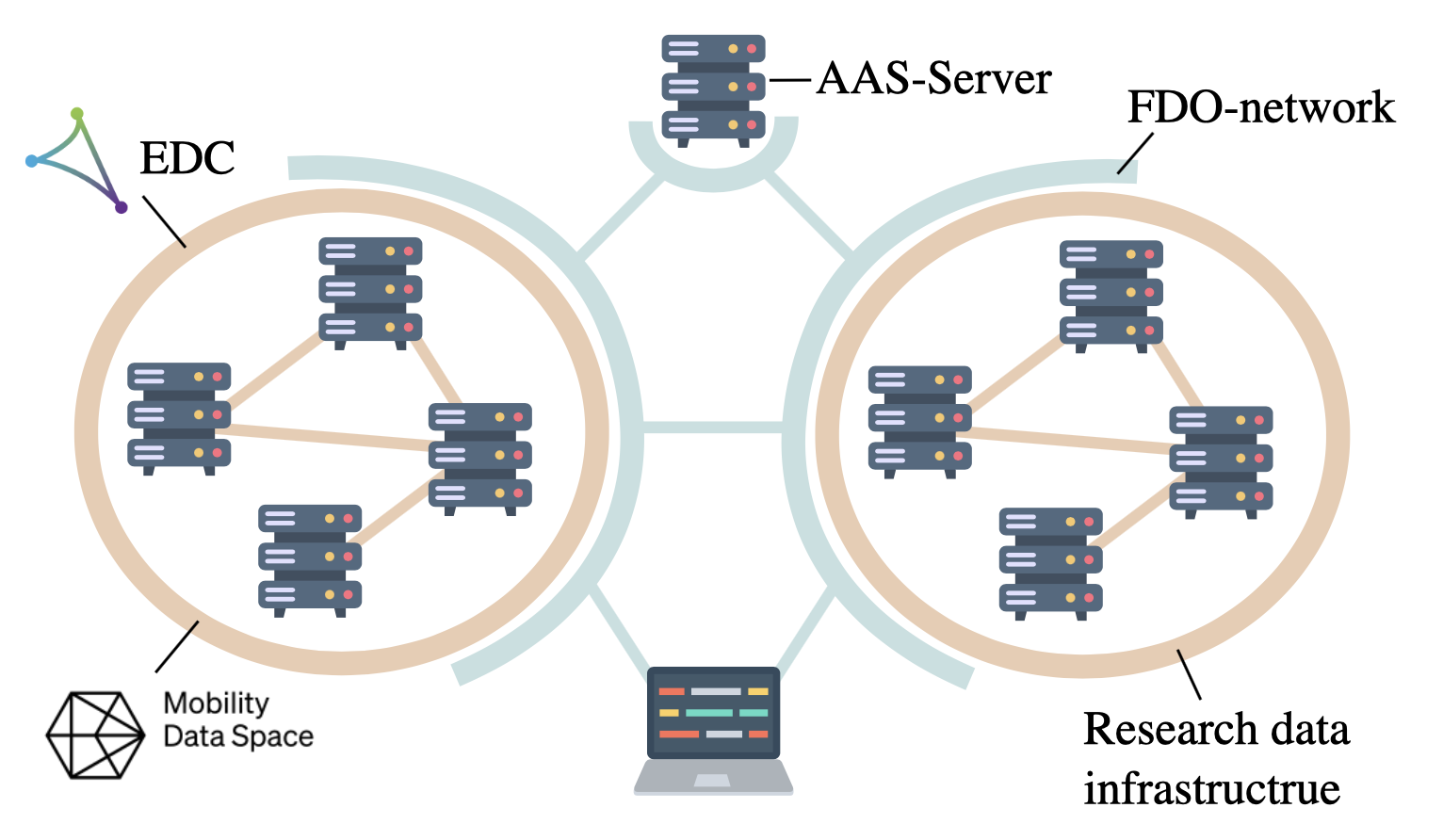
In FDO One, we demonstrate how FDOs can help to bridge those islands and even include other data infrastructures like public data repositories and even simple servers. While it is possible to connect complex and sophisticated structures like data spaces to the FDO network, those structures are not needed to participate, but the simplest data storage imaginable can be included.
We developed small software tools that connect two different kinds of data infrastructures to the FDO network:
- an FDO-EDC-Adapter; the Eclipse Dataspace Componentes (EDC) are a technolgy that can be used as the basis for data spaces. Prominent examples are the Mobility Data Space and the Catena-X Data Space.
- an FDO-AAS-Adapter; the Asset Administration Shell is an industry standard to model data and create digital twins; AAS Servers can be used to store and server data described using this standard
What do we achieve with this? To illustrate this question, let us consider the following scenario:
The innovative start-up easyFix (made up) provides a predictive maintenance service based on machine learning. For its models, the start-up needs lots of data on stress situations of the motor and battery complex of electric vehicles, both from extrem laboratory conditions as well as monitoring data from actual driving. Luckily, this data is available: The MDS has participants who offer the monitoring data and research institutes publish stress test using there research data infrastructure. There is even as standardized AAS description for this kind of data that is used by industry and research. But the needed data is just a tiny fraction of all the data available.
- How can easyFix find out where the required data is available?
- How can easyFix access the data stored in various different kinds of infrastructures?
- How can easyFix select the required data and sort out other data in an automated fashion?
FDO is the answer to all three questions! FDO servers as a unifying framework that can include the different data infrastructures, from the MDS to a simple AAS server run by a university. FDO requires metadata in a machine readable form and FDO profiles define how they can be interpreted. This allows to build up search indices where easyFix can find data candidates and by using the provided metadata, automated tools by easyFix can select and then retrieve exactly the data that is needed.
We demonstrate this in practice by connecting data from the MDS and from an AAS server to our FDO testbed. You can try it out here: https://manager.testbed.pid.gwdg.de/